

A natural phenomenon on a global scale.
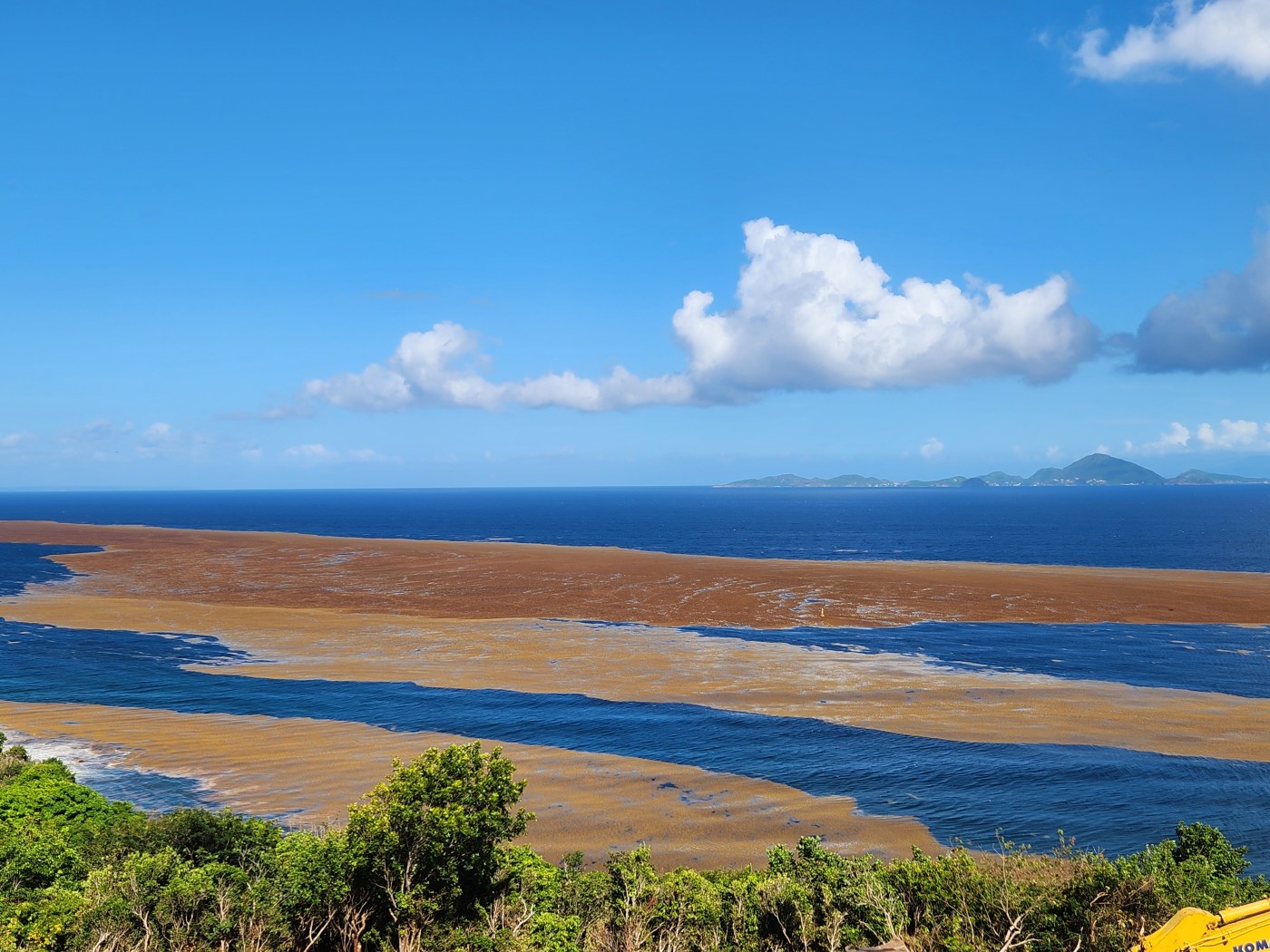
Amidst climate upheavals and ocean imbalances, sargassum is multiplying on the coasts of the Atlantic and the Caribbean. A new, complex, and global health and ecological challenge!
What are sargassum?
Sargassum are floating brown algae belonging to the genus Sargassum. Originally from the Sargasso Sea, an area located in the North Atlantic, they were historically part of a balanced ecosystem.
Since when?
As early as 1492, Christopher Columbus reported the presence of brown algae in his journal. A calm and mysterious area named the Sargasso Sea, which he crossed without incident before the discovery of Guadeloupe. An oceanographic map by Otto Krümmel dating from 1891 also attests to their presence in the Atlantic.
Now, and for over a decade, massive sargassum invasions have been severely disrupting coastal ecosystems, as well as economic activities and public health in tropical regions, particularly in Guadeloupe. These brown algae, once confined to the North Atlantic, are now proliferating on a global scale.

A global phenomenon
Since 2011, a “Great Atlantic Sargassum Belt” has formed. It stretches for almost 8,000 km.
The most affected countries are:
- Brazil, particularly the northern coast, where strandings are affecting marine ecosystems.
- Mexico, with tons of sargassum collected weekly in Cancun and Tulum, is severely affecting tourism.
- Florida, regularly impacted, particularly in the Keys.
- The Caribbean, as a whole, from the south of the Dominican Republic to Martinique.
The causes of proliferation
This phenomenon is multifactorial
Warming waters are stimulating the rapid growth of sargassum.
Massive nutrient inputs from rivers like the Amazon or Congo, often linked to agriculture, feed these algae.
Ocean currents modified by climate change are redistributing Sargassum masses to areas that are usually unaffected.
Environmental and human consequences
The impacts are manifold:
Ecological impacts: coral and seagrass suffocation, fish deaths, destruction of coastal biodiversity.
Restrooms: The decomposition of algae emits a toxic gas (H2S) causing headaches, nausea, and respiratory problems.
Economic: tourism paralysis, difficult fishing, devaluation of seaside real estate.
In Guadeloupe: A Daily Struggle

In Guadeloupe, the massive arrival of sargassum particularly affects the coasts of Grande-Terre, Marie-Galante, and the municipality of Capesterre-Belle-Eau. Since 2018, strandings have become almost constant between April and October. Despite collection efforts, beaches are regularly invaded and residents suffer from air pollution.
Guadeloupe has implemented emergency plans. And the search for valorization solutions (compost, biomaterials, biogas) is underway, but struggling to scale up. The fight against sargassum is essential for the economy and requires solutions that address the root of the problems.
The local population is organizing between resilience and exasperation, oscillating between waiting for structural solutions and the urgency of a health response. Sargassum, far from being a mere inconvenience, has become a major environmental, health, and social issue in Guadeloupe. The consequences of sargassum on Guadeloupe's economy cannot be ignored., and the island must continue to inspire dreams.
Should one cancel their vacation to Guadeloupe? Of course not!
It's important to put things in perspective: not all beaches in Guadeloupe are affected. The dream of beaches with crystal-clear water is still alive! Many areas remain perfectly suitable for swimming. This is particularly true on the Windward Coast (Basse-Terre), and regular clean-ups are limiting the nuisance in affected areas.
Your nature and serenity stay with the Green Bananas and Vert-Intense
To the eco-lodges Green Bananas, nestled in Saint-Claude, we are far from areas directly exposed to sargassum.
Close to the rainforest, naturally protected thanks to its altitude, its fresh springs, its mountain rivers.
And Intense Green, your adventure expert, offers you activities: volcanic hikes, river swimming, canyoning
Staying with us is experiencing Guadeloupe differently, in a healthy environment, far from mass tourism.
You will leave feeling refreshed, with a true connection to nature. All while supporting a local organization committed to environmental protection and the development of its territory.
To organize your stay in Guadeloupe Green Bananas at the foot of the Soufrière volcano, in the mountains.
To organize your activities in Guadeloupe Intense Green
Stranding Forecast Bulletin Pelagic sargassum in Guadeloupe by Météo-France Guadeloupe
